Medically reviewed by our reviewing veterinarian, DVM · September 2026 Formulas, life stages and health notes follow AVMA, AKC and AAHA guidance. How we review · Not a substitute for veterinary advice.
What are the dog life stages?
The dog life stages, following the 2019 AAHA Canine Life Stage Guidelines, are puppy, young adult, mature adult, senior and geriatric. Puppyhood ends at 1 year, young adulthood at 3, mature adulthood at 75 percent of expected lifespan, and the senior stage runs to the average lifespan, after which a dog is geriatric.
The AAHA guidelines replaced fixed age cutoffs with stages tied to expected lifespan, because a 7-year-old Great Dane and a 7-year-old Chihuahua are at very different points in life. Pawometer adds a geriatric stage for dogs that have outlived their size's average.
| Stage | Age (medium dog, 21 to 50 lb) | Human equivalent |
|---|
| Puppy | 0 to 1 year | 0 to 15 |
| Young adult | 1 to 3 years | 15 to 29 |
| Mature adult | 3 to 9 years | 29 to 59 |
| Senior | 9 to 12 years | 59 to 74 |
| Geriatric | 12+ years | 74+ |
Human equivalents use the size-adjusted formula the AVMA describes: 15 for the first year, 24 for the second, then 5 per year for a medium dog. Shift the senior and geriatric rows earlier for bigger dogs and later for smaller ones.
How long is a dog a puppy?
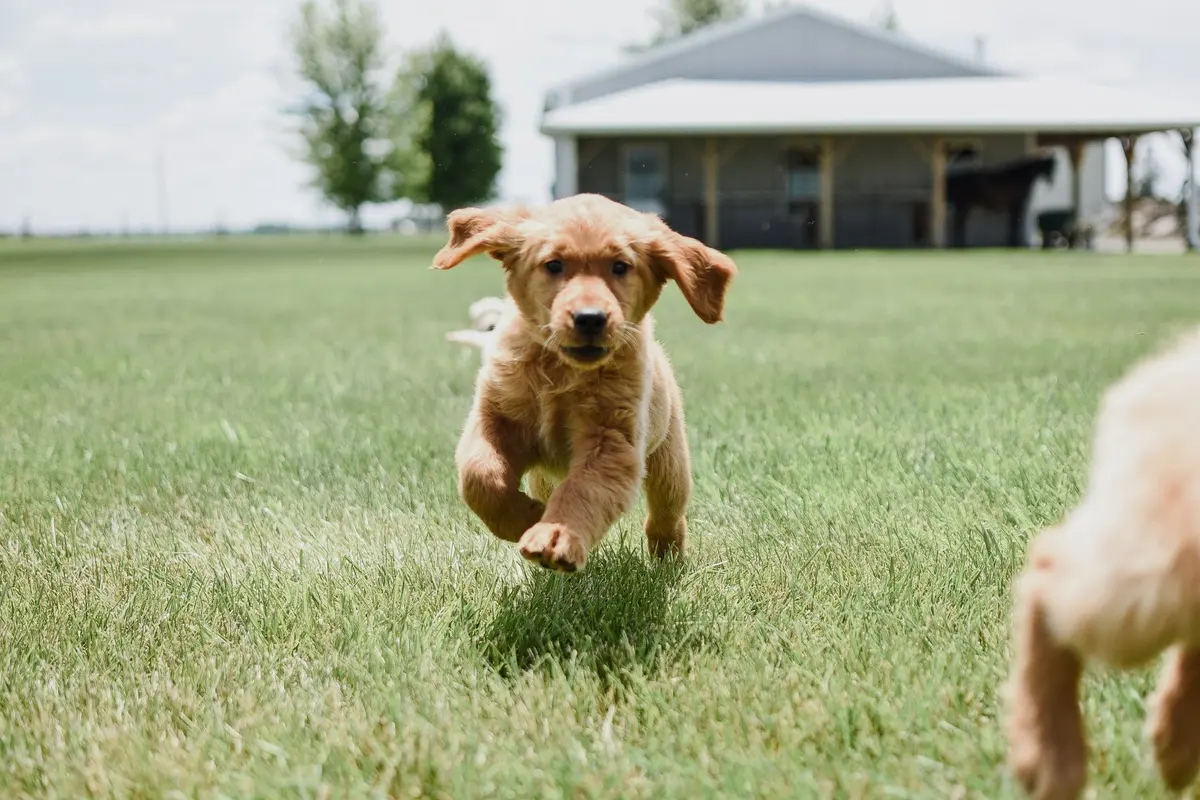
A dog is a puppy until about 1 year of age, when the calculator counts it as 15 human years. Small breeds finish growing around 9 to 12 months, while giant breeds keep adding bone until 18 to 24 months, so a Great Dane stays puppyish far longer than a Chihuahua.
Inside that first year, development is compressed. The calculator maps 3 months to 5 human years, 6 months to 10, 9 months to 12.5 and 12 months to 15, following the AVMA scale. Key milestones:
- 3 to 14 weeks: the socialization window that shapes adult temperament.
- 3 to 7 months: baby teeth fall out and adult teeth come in.
- 6 to 12 months: sexual maturity and adolescence, when training often seems to unravel.
- 12 to 24 months: giant breeds are still filling out and should stay on large-breed puppy food until growth plates close.
Puppies need a vaccine series, parasite control and a spay or neuter discussion before the first birthday.
When is a dog considered an adult?
A dog is considered an adult at 1 year old, the equivalent of about 15 human years, and a young adult until age 3, roughly 28 to 31 human years depending on size. Between 3 and about 75 percent of expected lifespan a dog is a mature adult, the longest and healthiest stage of life.
Adulthood covers most of a dog's life, so the AAHA splits it in two. Young adults (1 to 3 years) are physically mature but still learning; a 2-year-old is 24 in human years and a 3-year-old 28 to 31. Mature adults run from 3 until 75 percent of expected lifespan: about 10.5 years for toy dogs, 9.75 for small, 9 for medium, 8.25 for large and 6.4 for giants.
A 5-year-old sits squarely in mature adulthood at 36 (small), 39 (medium), 42 (large) or 45 (giant) human years. Care is about prevention: a yearly exam, dental care, a lean body and consistent exercise. Weight gain is the most common problem vets see at this stage.
When is a dog considered a senior?
A dog is considered a senior when it enters the last 25 percent of its breed's expected lifespan: about 10.5 years for toy breeds, 9.75 for small, 9 for medium, 8.25 for large and 6.4 for giant breeds. In human terms every size crosses into senior life at roughly 55 to 62 years old.
Senior status depends on size because lifespan does. Kraus, Pavard and Promislow (2013) showed that bigger dogs age faster in adulthood, losing about a month of expected life for every extra 4.4 lb.
| Size | Adult weight | Average lifespan | Senior from | Human equivalent |
|---|
| Toy | Under 10 lb | 14 years | 10.5 years | 58 |
| Small | 10 to 20 lb | 13 years | 9.75 years | 55 |
| Medium | 21 to 50 lb | 12 years | 9 years | 59 |
| Large | 51 to 90 lb | 11 years | 8.25 years | 62 |
| Giant | Over 90 lb | 8.5 years | 6.4 years | 55 |
Being a senior is not a diagnosis. Many dogs stay active and healthy well into this stage; the label tells you and your vet to look harder for early kidney, heart, joint and dental disease.

What is a geriatric dog?
A geriatric dog is one that has lived past the average lifespan for its size: beyond 14 years for toy breeds, 13 for small, 12 for medium, 11 for large and 8.5 for giant breeds. A 12-year-old Labrador (84 human years) is geriatric; a 12-year-old Chihuahua (64) is still a senior.
Geriatric is the stage past the point most dogs of that size reach. A 15-year-old dog is 76 human years if toy or small, 89 if medium, 102 if large and 115 if giant, which shows how remarkable a 15-year-old Labrador is.
Care shifts from prevention to comfort:
- Screening for canine cognitive dysfunction (disorientation, night waking, house-soiling).
- Pain management for arthritis, plus rugs and ramps for traction.
- Smaller, more frequent meals and easy access to water.
- Regular quality-of-life check-ins with the vet.
Geriatric dogs still benefit from short daily walks and mental games; stopping activity altogether speeds decline.
What changes at each life stage?
Each dog life stage changes the care plan. Puppies need vaccines, socialization and growth food; young adults need spay or neuter decisions, dental habits and weight control; mature adults need yearly exams and a lean body; seniors need checkups every 6 months, bloodwork, dental cleanings, joint support and gentler daily exercise.
| Stage | Vet visits | Dental | Weight and diet | Exercise |
|---|
| Puppy | Every 3 to 4 weeks until 16 weeks | Start brushing | Growth formula for the dog's size | Short play, no forced running |
| Young adult | Yearly | Daily brushing, first cleaning if needed | Adult food, watch post-neuter weight | Full activity |
| Mature adult | Yearly, baseline bloodwork | Cleanings as advised | Keep a visible waist | Steady daily exercise |
| Senior | Every 6 months, bloodwork and urinalysis | Yearly check, cleanings | Senior or joint diet, lean body | Shorter, more frequent walks |
| Geriatric | Every 6 months or sooner | Monitor for pain | Small frequent meals | Gentle, on soft surfaces |
Across the dog life stages, the twice-yearly senior exam is the most important change. Six months is a long time for a dog at 60-plus human years, and early bloodwork catches kidney and thyroid disease while it is still manageable.
Does spaying or neutering change life stage timing?
Spaying or neutering does not change when a dog stops being a puppy or becomes an adult, but it shifts the senior threshold. Banfield's 2013 State of Pet Health report found sterilized dogs live about a year longer, so the calculator adds 1 year of expected lifespan and delays senior status by about 9 months.
The Banfield report analyzed records from more than 2 million dogs and found neutered males and spayed females lived longer than intact dogs. Pawometer applies a flat 1 extra year of expected lifespan for sterilized dogs.
Because senior status starts at 75 percent of expected lifespan, that extra year moves the threshold by 9 months. For a neutered Labrador (large, 11 + 1 = 12 years expected), senior life begins at 9 instead of 8.25 and geriatric status at 12 instead of 11. The puppy and young adult boundaries in the dog life stages stay at 1 and 3 years.
Weight gain after surgery is the main trade-off, so watch the food bowl.
Frequently asked questions
When is a dog considered old?
A dog is considered old, or senior, in the final quarter of its expected lifespan: about 10.5 years for toy breeds, 9.75 for small, 9 for medium, 8.25 for large and 6.4 for giant. Past the average lifespan it is geriatric.
Is a 2-year-old dog still a puppy?
No. A 2-year-old is a young adult and about 24 in human years, whatever its size. It may still act playful, especially in large breeds, but its body is fully grown.
When is a dog considered an adult?
At 1 year old. A dog is a young adult from 1 to 3 and a mature adult from 3 until about 75 percent of its expected lifespan.
Is a 7-year-old dog a senior?
Only if it is a giant breed, which reaches senior status at about 6.4 years. A 7-year-old large dog is about a year away; small and medium dogs are still mature adults.
What is the difference between a senior and a geriatric dog?
A senior dog is in the last 25 percent of its expected lifespan; a geriatric dog has outlived the average for its size. For a medium dog that means senior from 9 to 12 years and geriatric after 12.