Medically reviewed by our reviewing veterinarian, DVM · September 2026 Formulas, life stages and health notes follow AVMA, AKC and AAHA guidance. How we review · Not a substitute for veterinary advice.
How old is my puppy in human years?
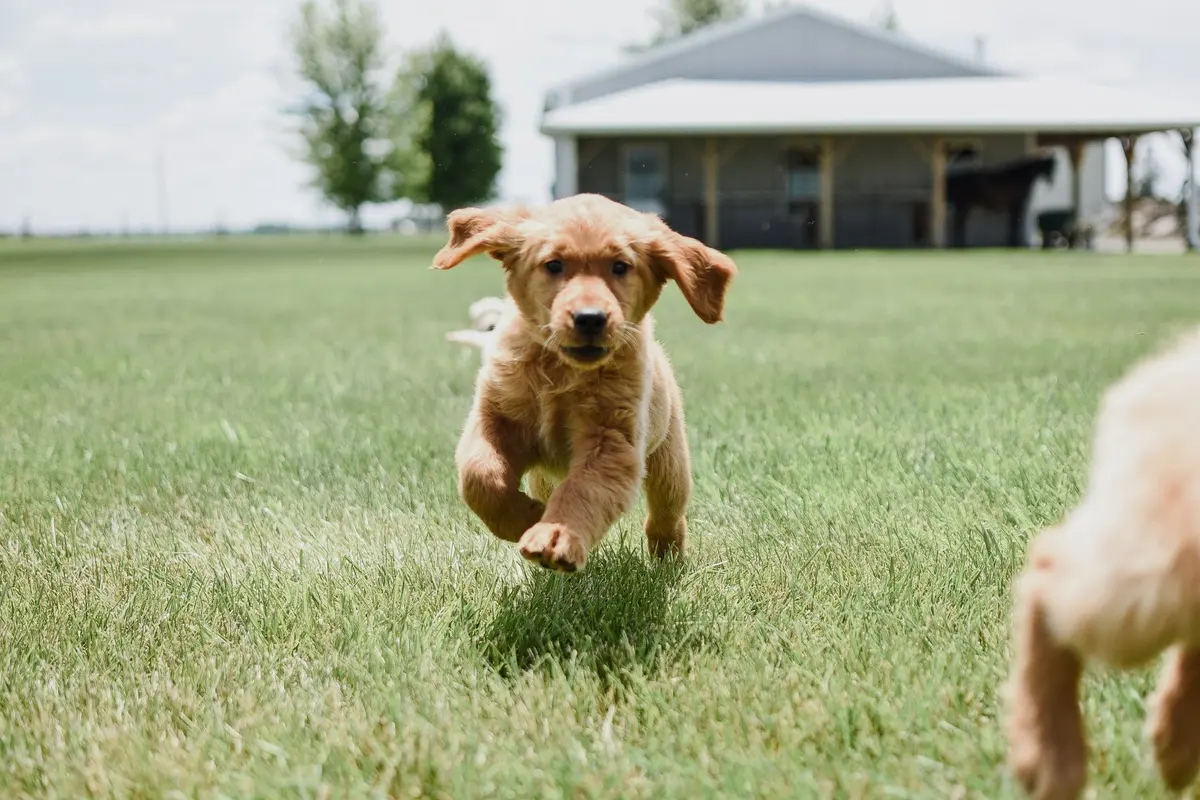
A puppy ages about 5 human years every 3 months during its first year: 8 weeks is about 3 human years, 3 months 5, 4 months 7, 6 months 10, 8 months 11.7, 9 months 12.5, 10 months 13.3 and 12 months 15. Every size follows the same curve until the first birthday.
The puppy age calculator interpolates between the first-year anchors used by the American Veterinary Medical Association and the American Kennel Club: 0 at birth, 5 human years at 3 months, 10 at 6 months, 12.5 at 9 months and 15 at 12 months.
| Puppy age | Human years | Human comparison |
|---|---|---|
| 8 weeks | 3 | Preschooler, just left the litter |
| 3 months | 5 | Kindergartner, learning rules |
| 4 months | 7 | Early grade school, losing baby teeth |
| 6 months | 10 | Pre-teen, start of adolescence |
| 8 months | 11.7 | Middle schooler |
| 9 months | 12.5 | Young teenager |
| 10 months | 13.3 | Teenager testing limits |
| 12 months | 15 | High schooler, nearly grown |
Notice that size does not appear in the table. Toy, medium and giant puppies all reach 15 human years at their first birthday and 24 at their second. Size only changes the math from year 3, when the yearly increment becomes 4 for small, 5 for medium, 6 for large and 7 for giant dogs.
How can you tell how old a puppy is?
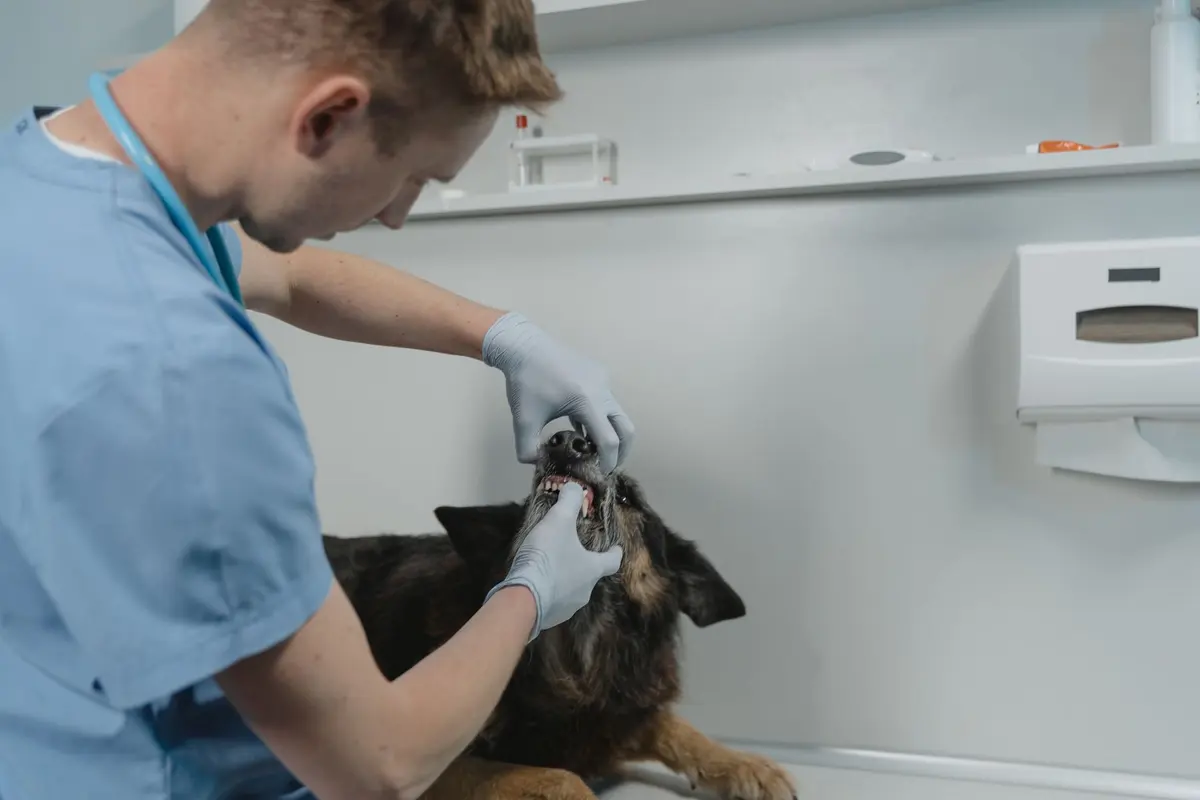
Teeth are the most reliable clue. No teeth means under 3 weeks, a full set of 28 needle-sharp baby teeth means about 8 weeks to 4 months, a mix of baby and adult teeth means 4 to 6 months, and 42 clean white adult teeth mean 7 months or older. Eyes, ears and body size confirm the estimate.
Shelters and veterinarians estimate age from the mouth first, because tooth eruption follows a predictable schedule described in the Merck Veterinary Manual.
| What you see | Estimated age |
|---|---|
| Gums only, no teeth | Under 3 weeks |
| Baby incisors and canines erupting | 3 to 5 weeks |
| All 28 deciduous (baby) teeth in | 6 to 8 weeks |
| Baby teeth present, adult incisors appearing | 3 to 4 months |
| Adult canines and premolars replacing baby teeth | 4 to 6 months |
| All 42 adult teeth in, bright white, no wear | 6 to 7 months to about 1 year |
| Slight yellowing, minor tartar on back teeth | 1 to 2 years |
Other clues help when teeth are ambiguous. Eyes open at about 2 weeks and ears open at about 3, so a puppy with closed eyes is a newborn. A puppy that walks confidently, plays with littermates and eats solid food is at least 6 weeks old, since weaning takes place at 6 to 8 weeks. Paw size relative to body, coat texture and, for many breeds, how close the puppy is to the breed's typical adult weight round out the picture. An estimate of plus or minus 2 weeks is normal for puppies under 4 months.
How long is a dog a puppy?
A dog is a puppy until about 12 months under veterinary life stage definitions, but physical growth ends at different ages by size: toy breeds reach adult size at 9 to 12 months, medium breeds around 12 months, large breeds at 12 to 18 months and giant breeds at 18 to 24 months. Mental maturity follows later.
The AAHA canine life stage guidelines define the puppy stage as birth to the end of rapid growth, which for practical purposes is the first birthday, followed by the young adult stage from 1 to 3 years. Growth plates, however, close on a size-dependent schedule.
- Toy and small breeds (under 20 lb): full height and near-final weight by 9 to 12 months.
- Medium breeds (21 to 50 lb): adult size at about 12 months, with some filling out through 15 months.
- Large breeds (51 to 90 lb): 12 to 18 months, with chest and muscle still developing after height stops.
- Giant breeds (over 90 lb): 18 to 24 months, which is why their joints need protection from stairs and hard landings for so long.
Behaviorally, most dogs act like puppies well past their growth. Adolescence typically runs from 6 to 18 months, and many owners of large and giant breeds report a puppy-like brain until age 2 or even 3. In human years that lines up neatly: a 2-year-old dog is 24, and a 3-year-old is 28 to 31.
What are the puppy milestones by age?
Eyes open at about 2 weeks and ears at 3 weeks; weaning happens at 6 to 8 weeks, and 8 weeks is the earliest recommended adoption age. DHPP vaccines start at 6 to 8 weeks, baby teeth are replaced by 42 adult teeth by 6 to 7 months, and full size comes between 9 and 24 months by breed size.
Development in the first year follows a schedule that varies little between breeds. Vaccine timing follows the 2022 AAHA canine vaccination guidelines.
- Birth to 2 weeks: eyes and ears closed, sleeps and nurses, cannot regulate body temperature.
- 2 weeks: eyes open. 3 weeks: ear canals open, first wobbly steps.
- 3 to 5 weeks: baby teeth erupt, play with littermates begins.
- 6 to 8 weeks: all 28 deciduous teeth in, weaning completes, first DHPP (distemper, hepatitis, parainfluenza, parvovirus) dose at 6 to 8 weeks.
- 8 weeks: earliest recommended age to go to a new home. About 3 human years.
- 10 to 12 weeks: second DHPP dose. Peak socialization window.
- 12 to 16 weeks: rabies vaccine, and third DHPP dose at 14 to 16 weeks.
- 4 to 6 months: teething. Adult incisors, canines and premolars push out baby teeth; expect chewing.
- 6 to 7 months: all 42 adult teeth in. About 10 human years. Sexual maturity begins.
- 9 to 24 months: adult size, earliest for toys and latest for giants.
Bring the dates of each vaccine dose to the vet; the calculator on this page can help you confirm the puppy's age when paperwork is missing.
Is a 6-month-old puppy a teenager?
Yes. A 6-month-old puppy is about 10 human years old on the veterinary scale and entering canine adolescence, which runs roughly from 6 to 12 months and brings sexual maturity, selective hearing and testing of rules. Hormones peak, adult teeth are nearly in, and consistent training matters most now.
The 6-month mark is where many owners feel their well-behaved puppy has been swapped for a different dog. That is normal. In human years the puppy has just turned 10 and will be 15 by its first birthday, compressing the entire tween and teen period into 6 months. Expect three things.
- Selective recall. A puppy that came running at 4 months may ignore you at 7 months. Keep rewarding recall generously and use a long line in open spaces.
- Hormonal changes. Females may have a first heat between 6 and 12 months, and males begin marking. Talk to your vet about the timing of spay or neuter, which differs by breed size.
- Big-dog mouth, puppy brain. The last adult molars come in around 6 to 7 months, so chewing peaks just as the dog is strong enough to destroy furniture.
Adolescence fades gradually. By 12 months (15 human years) most dogs have settled, and by 2 years (24 human years) the young adult stage is well under way. Giant breeds take the longest, often until 2 years or more.
When should I switch from puppy food?
Switch from puppy food when growth is essentially complete: about 9 to 12 months for toy and small breeds, 12 months for medium breeds, 12 to 18 months for large breeds and 18 to 24 months for giant breeds. Large and giant puppies should eat a large-breed puppy formula until then, and your vet can confirm timing.
Puppy food is denser in calories, protein and minerals to fuel rapid growth, and the Merck Veterinary Manual notes that large-breed puppies in particular need controlled calcium and energy levels to avoid growing too fast, which stresses developing joints. The switch date therefore tracks the growth timeline by size rather than a single birthday.
- Toy and small breeds: 9 to 12 months.
- Medium breeds: around 12 months.
- Large breeds: 12 to 18 months, using a large-breed puppy formula throughout.
- Giant breeds: 18 to 24 months, again on a large-breed formula.
Make the change over 7 to 10 days by mixing increasing amounts of adult food into the puppy food, which limits stomach upset. If your puppy was spayed or neutered, ask your vet whether to switch slightly earlier or reduce portions, because energy needs often drop after surgery. When in doubt, a body condition check at the 12-month visit is the best guide.
Sources
Frequently asked questions
How old is a 6-month-old dog in human years?
A 6-month-old puppy is about 10 in human years, the same for every breed size. It is entering adolescence and will reach 15 human years at its first birthday.
How old is a 4-month-old puppy in human years?
A 4-month-old puppy is about 7 in human years. This is the age when baby teeth begin to fall out and adult incisors appear, so expect chewing and the occasional tooth on the floor.
How old is an 8-week-old puppy in human years?
An 8-week-old puppy is about 3 in human years. Eight weeks is also the earliest recommended age for a puppy to leave its mother and littermates and the age of the first DHPP vaccine dose.
Can I tell a puppy's age by its weight?
Only roughly, and only if you know the breed. Teeth are far more reliable: 28 baby teeth by 8 weeks, adult teeth replacing them from 4 months, and all 42 adult teeth by 6 to 7 months. Weight helps confirm the estimate for purebreds with a known adult size.
Does a puppy's breed size change its age in human years?
Not during the first two years. All puppies are 15 human years at 12 months and 24 at 2 years. From year 3, toy and small dogs add 4 human years per year, medium 5, large 6 and giant 7.
When is a puppy fully grown?
Toy breeds are fully grown at 9 to 12 months, medium breeds at about 12 months, large breeds at 12 to 18 months and giant breeds at 18 to 24 months. Behavioral maturity usually arrives 6 to 12 months after physical growth ends.