Medically reviewed by our reviewing veterinarian, DVM · September 2026 Formulas, life stages and health notes follow AVMA, AKC and AAHA guidance. How we review · Not a substitute for veterinary advice.
How can you tell how old a dog is?
You can tell how old a dog is by combining four physical clues: teeth (eruption, wear and tartar), eyes (a bluish haze after 6 to 8 years), coat (gray around the muzzle from 5 to 7 years) and body condition (muscle loss and stiffness in seniors). Teeth give the tightest estimate; the rest narrow it down.
Most adopted dogs arrive without a birth date, so age has to be read from the body itself. Vets know how to tell how old a dog is this way, and you can do a first pass at home. Puppies are easiest because teeth erupt on a tight schedule; adults between 1 and 5 are hardest, fully grown and not yet showing wear.
Work through the clues in order: teeth, eyes, coat, body. Write down a range rather than a single number, then confirm it at the next exam. If you arrived from the calculator, use the Back to calculator link at the top of this guide once you have an estimate and enter it with your dog's adult weight.
How do teeth show a dog's age?
Teeth are the most reliable age clue. Deciduous teeth erupt at 2 to 4 weeks and the full baby set is in by 8 weeks; adult incisors arrive at 3 to 5 months and all 42 adult teeth by 6 to 7 months. After that, wear, yellowing and tartar accumulate at a predictable pace.
Dental development and wear follow a schedule the Merck Veterinary Manual describes for puppies and adults:
| What you see | Estimated age |
|---|---|
| First deciduous (baby) teeth erupting | 2 to 4 weeks |
| All 28 baby teeth present | 8 weeks |
| Adult incisors coming in | 3 to 5 months |
| All 42 adult teeth in, white and sharp | 6 to 7 months |
| Slight wear on incisors, mild yellowing | 1 to 2 years |
| Tartar on back teeth (premolars, molars) | 3 to 5 years |
| Heavy wear, gum disease, possible loose teeth | 5 to 10 years |
| Missing or worn-down teeth | 10+ years |
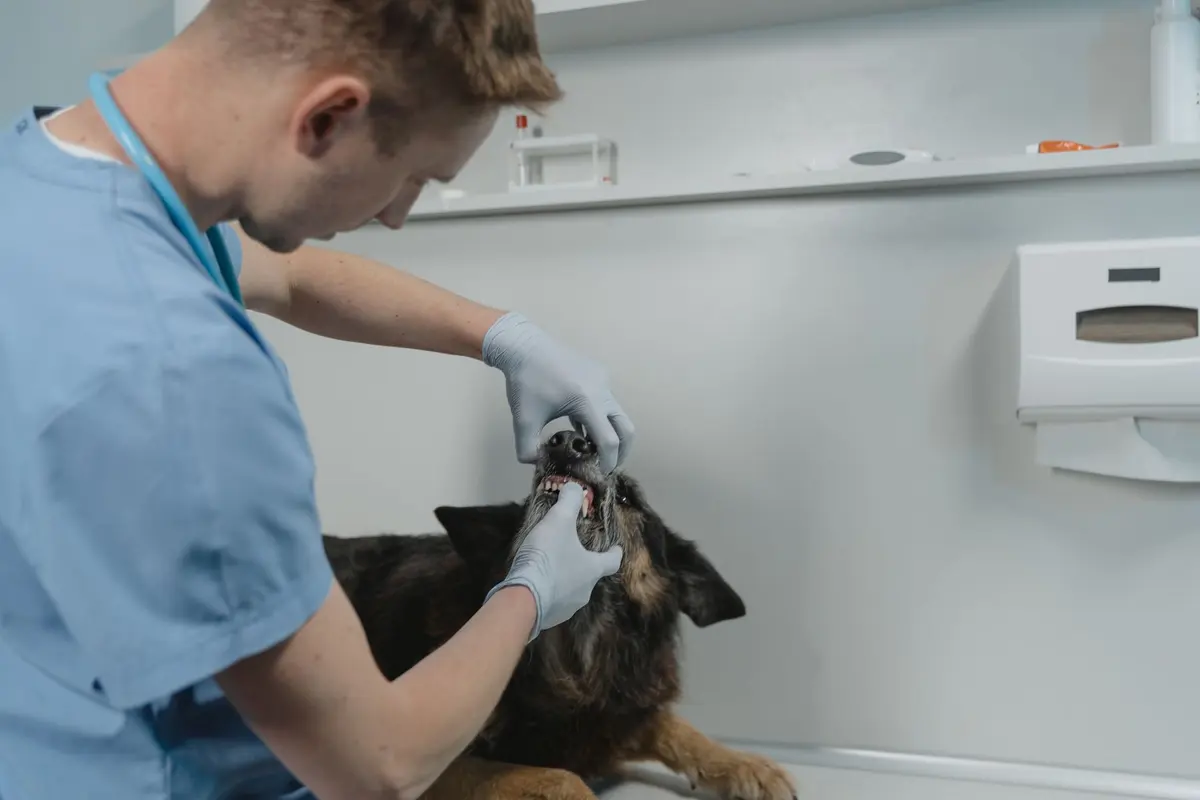
Lift the lip and look at the incisors (small front teeth) and the large upper premolars. Heavy chewers wear teeth faster, and a dog that has had professional cleanings looks younger than it is.

What do a dog's eyes reveal about age?
A dog's eyes show age through lenticular sclerosis, a bluish-gray haze in the center of the lens that typically appears after 6 to 8 years and does not impair vision much. Dense white cloudiness, by contrast, suggests cataracts, which are more common in older dogs but can occur at any age.
Lenticular (nuclear) sclerosis is a normal hardening of the lens fibers. It looks like a soft blue-gray reflection deep in the pupil, usually in both eyes, and rarely affects daily vision. Its appearance from about 6 to 8 years is one of the more consistent markers of middle age in dogs of every size.
Do not confuse it with cataracts, which look opaque and white and block light. Cataracts can be inherited or caused by diabetes at any age, so they are a health signal rather than an age clue. Older eyes also look slightly sunken and drier, with a slower pupil response.

When does a dog's muzzle turn gray?
Most dogs show gray or white hairs around the muzzle and eyes between 5 and 7 years, spreading across the face and chest by 10. Graying is a rough clue: dark coats show it earlier, light coats hide it, and stress or genetics can gray a dog as young as 2.
Gray hair in dogs works much as it does in people. It begins in the whiskers and fur around the mouth, then spreads to the eyebrows, cheeks and chest. By 10 years most dogs have an obviously frosted face.
Coat texture is a quieter clue. Puppy fluff is replaced by the adult coat at 4 to 6 months. Senior coats become thinner, coarser and duller, shed unevenly, and callused skin shows on the elbows and hocks from years of lying down. Nails grow thicker and more brittle, and the footpads lose their softness.
How do body, muscle tone and mobility change with age?
Young adult dogs have firm muscle, a defined waist and springy movement. From roughly 7 years in large breeds and 9 in small ones, dogs lose muscle over the hips and spine, rise more slowly and hesitate on stairs. Thickened footpads and calluses also point to an older dog.
Run your hands along the back and hips. A young adult feels muscular and symmetrical; a senior often feels bony over the spine and pelvis even at a healthy weight, because muscle declines with age. Watch the dog rise from lying down and climb a few steps. Stiffness after rest, a shortened stride and reluctance to jump into the car all point past middle age.
Set these signs against the AAHA life stage thresholds: senior life starts around 8.25 years for large breeds, 9 for medium and 9.75 for small, so clear mobility changes in a 40 lb dog suggest 9 or older.
How do vets estimate a rescue dog's age?
Vets estimate a rescue dog's age by scoring teeth, eyes, coat, muscle and joints together, then placing the dog in a range such as 2 to 4 or 8 to 10 years. For adults the estimate is usually within about 2 years; for puppies under 6 months, within a few weeks.
In the exam room a vet scores each system, then adjusts for size, because a Great Dane at 6 looks older than a Beagle at 6. Two tools narrow the range:
- X-rays: growth plates in the long bones close between roughly 12 and 18 months, so an open plate proves a dog is under about 1.5 years.
- Bloodwork: kidney and liver values, thyroid levels and red cell counts drift predictably with age and can support or challenge a visual estimate.
Shelters usually record the middle of the range as the official birthday. The calculator then converts it into human years by size: 15 for the first year, 24 for the second, then 4 to 7 per year.

Can a DNA test tell a dog's age?
Yes. An epigenetic DNA test estimates a dog's age from methylation patterns in a cheek swab or blood sample, a method validated by UC San Diego research published in 2020. Standard breed-ancestry kits do not report age; you need a test that specifically measures methylation.
The Wang et al. 2020 study in Cell Systems mapped methylation changes in Labrador retrievers against humans and derived the formula human age = 16 × ln(dog age) + 31. By that clock a 1-year-old dog is 31, a 5-year-old 57 and a 10-year-old 68.
The same principle powers epigenetic age tests for dogs, which read methylation from a cheek swab and return an estimated calendar age. They cost more than a vet estimate and were calibrated mostly on Labradors, so treat the result as another data point. Pawometer's Science mode lets you compare the DNA formula with the size-adjusted result.
Sources
Frequently asked questions
How can you tell how old a puppy is?
Use the teeth. Baby teeth erupt at 2 to 4 weeks, the full set is in by 8 weeks, adult incisors appear at 3 to 5 months and all adult teeth by 6 to 7 months. Eyes open at about 2 weeks.
How do you determine a dog's age without papers?
Combine teeth, eyes, coat and body condition into an age range, then ask a vet to confirm it. For adult dogs the estimate is usually within about 2 years.
How accurate is a vet's estimate of a dog's age?
For puppies under 6 months it can be accurate to within a few weeks. For adults it is typically a 2 to 3 year range, and it gets less precise after 5.
Does gray hair mean my dog is old?
Not necessarily. Graying usually starts between 5 and 7 years, but genetics and stress can gray a muzzle as early as 2, and pale coats hide it. Use it alongside teeth and eyes.
How do I know how old my dog is in human years?
Once you have an estimated calendar age, apply the size-adjusted formula: 15 for year one, 24 for year two, then 4 to 7 per year by size. The Pawometer calculator does this for you.