Medically reviewed by our reviewing veterinarian, DVM · September 2026 Formulas, life stages and health notes follow AVMA, AKC and AAHA guidance. How we review · Not a substitute for veterinary advice.
How do you read the dog years chart?
Find your dog's age in the first column, then move across to the column for its adult weight: toy under 10 lb, small 10 to 20 lb, medium 21 to 50 lb, large 51 to 90 lb, giant over 90 lb. The number where row and column meet is the human age equivalent. A 5-year-old medium dog reads 39.
The chart above follows the size-adjusted method recommended by the American Veterinary Medical Association and the American Kennel Club. Three tips make it easier to use.
- Use adult weight, not current weight. A 6-month-old Labrador may weigh 45 lb, but it belongs in the large column because it will finish near 70 lb.
- Round to the nearest year. A dog that is 4 years and 8 months is closest to the 5-year row. For a more precise figure, the calculator on the home page accepts months.
- Mixed breeds go by weight too. The chart does not care about breed, only about the weight class, so a 35 lb mixed breed reads from the medium column.
For a quick check, remember three rows: a 3-year-old dog is 28 to 31, a 7-year-old is 44 to 59, and a 12-year-old is 64 to 94 depending on size.
Dog age chart by size: what do the columns mean?
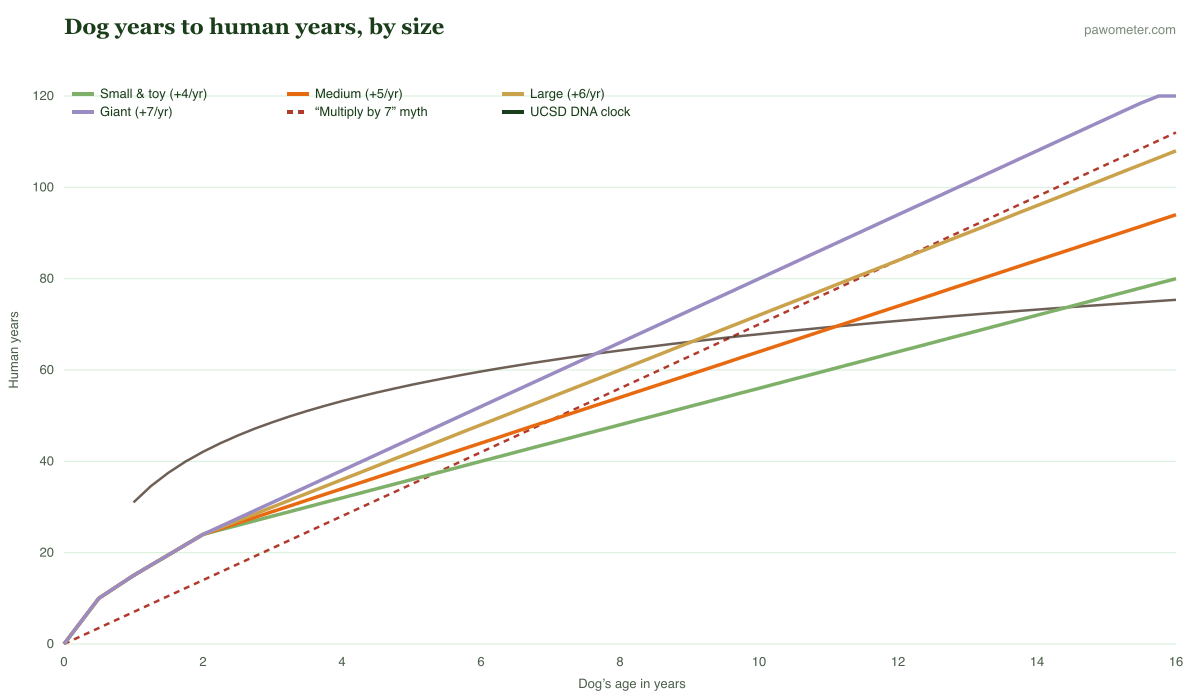
Each column is a weight class with its own aging rate after year 2: toy and small dogs add 4 human years per dog year, medium 5, large 6 and giant 7. All sizes share 15 at year 1 and 24 at year 2, so the columns only separate from year 3, when a dog reads 28 to 31.
The columns exist because size predicts aging speed in dogs more strongly than breed does. A study of more than 50,000 dogs by Kraus, Pavard and Promislow (2013) showed that large breeds die younger primarily because they age faster once they reach adulthood, which is exactly what the diverging columns show.
| Column | Adult weight | Human years added per dog year after 2 | Average lifespan | Typical breeds |
|---|---|---|---|---|
| Toy | Under 10 lb | 4 | 14 years | Chihuahua, Yorkshire terrier, Pomeranian |
| Small | 10 to 20 lb | 4 | 13 years | Dachshund, Boston terrier, Shih Tzu |
| Medium | 21 to 50 lb | 5 | 12 years | Beagle, Border collie, Bulldog |
| Large | 51 to 90 lb | 6 | 11 years | Labrador, German shepherd, Golden retriever |
| Giant | Over 90 lb | 7 | 8.5 years | Great Dane, Mastiff, Saint Bernard |
Toy and small dogs share a rate and differ only in average lifespan, which is why their columns match but their life stages, drawn from the AAHA life stage guidelines, start the senior stage at different ages: 10.5 for toys and 9.75 for small dogs.
Why isn't the dog years chart a straight line?
Dogs mature extremely fast in their first two years and then age at a steady, slower pace, so the chart jumps 15 human years in year 1, another 9 in year 2, and only 4 to 7 per year afterward. A straight 7-to-1 line would call a 1-year-old dog a 7-year-old child, which is biologically wrong.
By its first birthday a dog has adult teeth, is sexually mature and has reached most of its adult height, which in human terms is mid-adolescence, not early childhood. That is why the first row of every dog years chart says 15 rather than 7. The second year finishes physical and much of the social development, worth another 9 human years. After that, aging becomes a matter of gradual wear, and the yearly increment settles at a size-dependent constant.
Genetics backs up the curve. In 2020, Wang and colleagues compared DNA methylation patterns in Labrador retrievers with those of humans and found the best fit was logarithmic: human age = 16 × ln(dog age) + 31. Under that epigenetic clock a 1-year-old dog is about 31, a 2-year-old about 42, and a 10-year-old about 68. The numbers differ from the veterinary chart, especially early, but the shape is the same: steep at first, then flattening. A straight line cannot describe either.
Canine age chart for puppies under 1 year
Puppies of every size age about 5 human years per 3 months during their first year: 2 months is about 3 human years, 3 months 5, 4 months 7, 6 months 10, 8 months 11.7, 9 months 12.5, 10 months 13.3 and 12 months 15. Size only starts to matter after the second birthday.
The main chart starts at year 1, so use this canine age chart for a puppy. It interpolates between the veterinary anchors of 0 at birth, 5 at 3 months, 10 at 6 months, 12.5 at 9 months and 15 at 12 months.
| Puppy age | Human years | Development stage |
|---|---|---|
| 2 months | 3.3 | Weaned, earliest adoption age at 8 weeks |
| 3 months | 5 | Socialization window, second DHPP shot |
| 4 months | 6.7 | Baby teeth start falling out |
| 6 months | 10 | Adolescence begins |
| 8 months | 11.7 | All 42 adult teeth are in |
| 9 months | 12.5 | Toy breeds near adult size |
| 10 months | 13.3 | Peak adolescent testing |
| 12 months | 15 | Young adult |
Growth finishes at different ages by size, from 9 to 12 months for toy breeds to 18 to 24 months for giants, but the human-year equivalent is the same across sizes until the chart splits at year 3. The puppy age calculator covers weeks, teeth timelines and milestones in more detail.
Where do this chart's numbers come from?
The chart uses the size-adjusted guidance published by the American Veterinary Medical Association and the American Kennel Club: 15 human years for year 1, 24 for year 2, then 4, 5, 6 or 7 per year by weight class. Lifespans and life stages come from AAHA and from Kraus et al. (2013).
Every figure on this page can be traced to a named source, and none of them is invented for the site.
- Year 1 and year 2 values (15 and 24) and the size-based increments come from the AVMA, which summarizes the same guideline the AKC publishes.
- Size-dependent aging speed is supported by Kraus et al. (2013) in The American Naturalist.
- Life stages (puppy, young adult, mature adult, senior, geriatric) follow the 2019 AAHA canine life stage guidelines, which define senior as the last 25 percent of expected lifespan.
- The logarithmic epigenetic clock shown for comparison is from Wang et al. (2020) in Cell Systems.
- Health and development facts such as tooth counts and maturity ages are checked against the Merck Veterinary Manual.
The whole page is reviewed by a licensed veterinarian; see the veterinary review page for the process and the current review date.
Sources
Frequently asked questions
How old is a 7-year-old dog in human years?
A 7-year-old dog is 44 in human years if it is a toy or small breed, 49 if medium, 54 if large and 59 if giant. For a giant breed, age 7 is already past the start of the senior stage, which begins around 6.4 years.
Is a 10-year-old dog old?
Yes for most sizes. A 10-year-old dog is a senior if it is small, medium or large (56, 64 or 72 in human years) and geriatric if it is a giant breed at 80 human years, beyond the 8.5-year average lifespan. Only toy breeds, which start the senior stage at about 10.5 years, are still mature adults at 10.
How old is a 2-year-old dog in human years?
A 2-year-old dog is 24 in human years regardless of size. Size only begins to change the chart at year 3, when the columns read 28, 29, 30 and 31.
How old is a 15-year-old dog in human years?
A 15-year-old dog is 76 in human years if toy or small, 89 if medium, 102 if large and 115 if giant. A 15-year-old is geriatric in every size class because it has outlived the average lifespan for its weight.
What is 1 dog year in human years?
A dog's first year equals about 15 human years, not 7, because a 1-year-old dog is sexually mature and nearly full grown. After age 2, one dog year is worth 4 human years for small dogs, 5 for medium, 6 for large and 7 for giant breeds.
Does a Labrador age differently from a Chihuahua on the chart?
Yes. A Labrador reads from the large column and gains 6 human years per dog year after age 2, while a Chihuahua reads from the toy column and gains 4. At age 10 the Labrador is 72 in human years and the Chihuahua is 56.