How Old Is 3 in Dog Years?
A 3-year-old dog is about 28 human years if small, 29 if medium, 30 if large and 31 if giant, according to the AVMA size-adjusted model; the sizes begin to separate at this birthday.
How old is 3 in dog years? For the first time the answer depends on your dog's weight: 28 for a dog under 20 lb, 29 for 21 to 50 lb, 30 for 51 to 90 lb and 31 for a giant over 90 lb. Three is also the birthday when a dog leaves the young adult stage and enters mature adulthood. Your dog is at full physical and mental capacity, which makes this the prime of life for working, sport and companion dogs alike.
3 dog years in human years, by size
| Dog size | Typical weight | Human years | Life stage at 3 |
|---|---|---|---|
| Toy | under 10 lb | 28 | Mature adult |
| Small | 10–20 lb | 28 | Mature adult |
| Medium | 21–50 lb | 29 | Mature adult |
| Large | 51–90 lb | 30 | Mature adult |
| Giant | over 90 lb | 31 | Mature adult |
Science mode (UCSD DNA clock, any size): about 49 human years. Life stage follows the AAHA guidelines and the average lifespan for each size.
Is a 3-year-old dog an adult?
Yes. The AAHA guidelines end the young adult stage at three and start the mature adult stage, which lasts until the dog has lived about 75 percent of its expected lifespan. A 3-year-old dog has settled energy, a formed personality and the physical maturity of a human in the late twenties or around thirty.
Under the AAHA canine life stage guidelines, 3 in dog years is the start of mature adulthood for every size. For a toy breed with an average lifespan of 14 years this stage will last more than seven years; for a giant breed averaging 8.5 years it will last only about three and a half.
Care priorities for a 3-year-old dog:
- Annual exam, vaccines on the schedule your vet recommends, and year-round parasite prevention.
- Weight management, because metabolism starts to slow slightly after the young adult years.
- Professional dental cleaning, since periodontal disease is already present in most dogs by age 3.
- Mental work: a 3-year-old Australian Shepherd or Poodle that is bored will invent its own job.
Why does a giant dog count as 31 while a small dog is 28?
Because after year two the size-adjusted model adds a different number of human years per calendar year: four for small dogs, five for medium, six for large and seven for giant. At 3 that produces 28, 29, 30 and 31. The gap is only three human years now but grows by three more every year.
The AVMA size-adjusted chart reflects a real biological pattern: bigger dogs live shorter lives and age faster in adulthood. Kraus et al. (2013) found that every 4.4 lb of adult body mass costs a dog roughly one month of expected lifespan, which is why a 150 lb Great Dane and a 6 lb Chihuahua have such different life expectancies.
What this means at 3 dog years in human years:
- A 3-year-old Chihuahua (28) has about eleven years ahead on average.
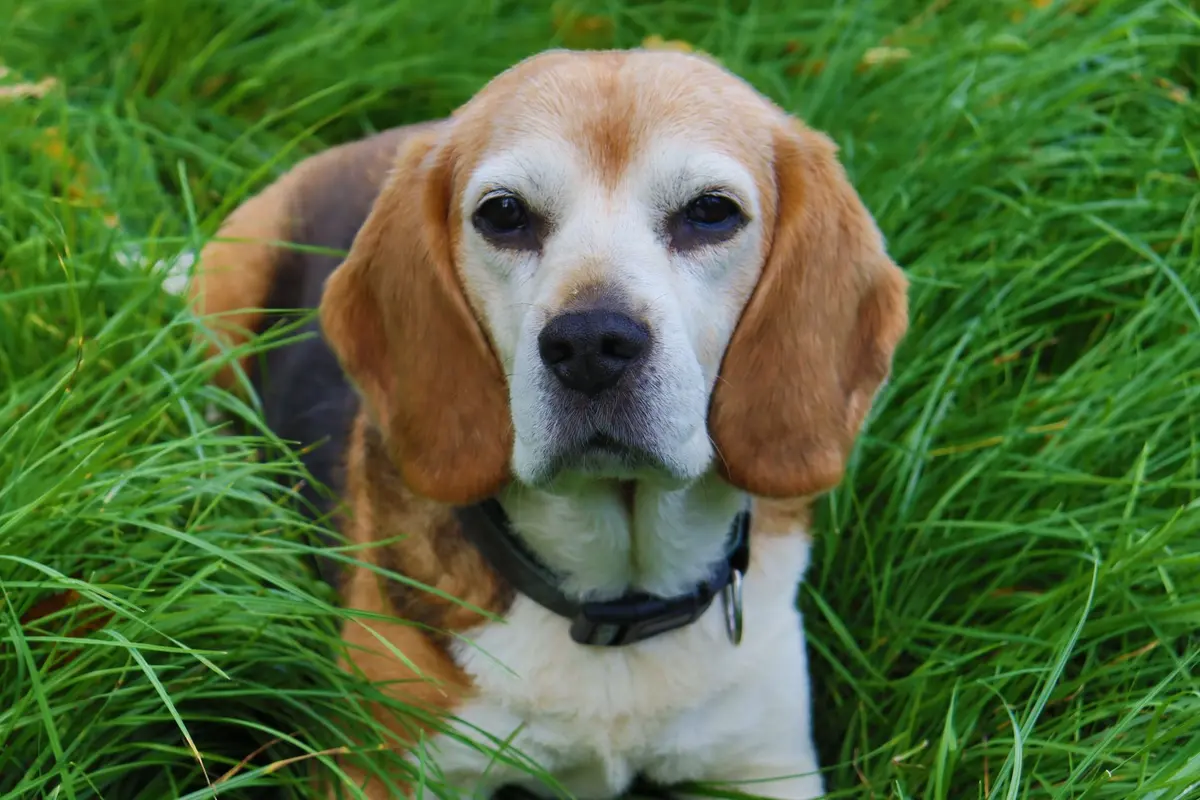
- A 3-year-old Beagle (29) has about nine.
- A 3-year-old Labrador (30) has about eight.
- A 3-year-old Great Dane (31) has around five and a half, and will be considered senior in just over three years.
The science behind 3 in dog years
The multiply by seven myth says a 3-year-old dog is 21, which lines up better than it does at younger ages but is still off. The AVMA model gives 28 to 31, and the UCSD epigenetic formula puts a 3-year-old dog at about 49 human years on the molecular clock.
The seven year rule is not based on any study; the AVMA calls it a rough rule of thumb that ignores both size and the front loaded nature of canine development.
The epigenetic approach comes from Wang et al. (2020, Cell Systems), who mapped methylation changes in 104 Labrador Retrievers against human data and fitted human age = 16 ln(dog age) + 31. Plug in 3 and you get roughly 49. Why so much higher than 28 to 31? Because canine DNA methylation changes fastest in the first few years, then slows, so the epigenetic curve runs ahead of the life stage chart in youth and behind it in old age. Pawometer shows both so you can compare.
Nearby ages on the chart
| Dog’s age | Small 10–20 lb | Medium 21–50 lb | Large 51–90 lb | Giant over 90 lb | DNA clock |
|---|---|---|---|---|---|
| 1 year | 15 | 15 | 15 | 15 | 31 |
| 2 years | 24 | 24 | 24 | 24 | 42 |
| 3 years | 28 | 29 | 30 | 31 | 49 |
| 4 years | 32 | 34 | 36 | 38 | 53 |
| 5 years | 36 | 39 | 42 | 45 | 57 |
See the full dog years chart (1–20 years, five sizes) →
Frequently asked questions
Is 3 years old considered middle-aged for a dog?
Not quite. At 3 a dog is a mature adult in its prime, not middle-aged. Middle age is better described as the last part of the mature adult stage, which arrives around 5 for giant breeds and around 8 for toy breeds.
How old is 3 in dog years for a Golden Retriever?
A 3-year-old Golden Retriever is a large breed dog, so it is about 30 in human years. Each further year will add six human years, so it will be 36 at 4 and 42 at 5.
Can a 3-year-old dog still be trained?
Absolutely. A 3-year-old has a longer attention span and better impulse control than a puppy, so many trainers find this a productive age. The socialization window closed long ago, but new skills and habits remain very learnable.
Medically reviewed by our reviewing veterinarian, DVM · September 2026 Formulas, life stages and health notes follow AVMA, AKC and AAHA guidance. How we review · Not a substitute for veterinary advice.